

Villefranche-de-Rouergue, Franța · România
Chirurgie Oncologică
Colo-proctologică
Chirurgie oncologică colorectală minim invazivă — laparoscopică și robotică — cu respectarea principiilor oncologice de rezecție și reconstrucție anastomotică. Experiență acumulată în centre universitare din Franța.
About the condition
What is colorectal surgery and what role does it play in the treatment of colorectal cancer?
Colorectal surgery (coloproctology) is the specialty dedicated to the diagnosis and treatment of conditions of the colon, rectum and anal canal, including colorectal cancer. This surgical field plays an essential role in the management of colorectal tumours, being the main curative treatment for the majority of patients.
Colorectal cancer comprises the malignant tumours of the colon and rectum. It is one of the most common cancers worldwide, ranking third in incidence and second in cancer mortality in Europe.
Most cases begin as benign polyps (adenomas) which, if left untreated, can progress gradually to cancer. For this reason, early detection and access to specialised colorectal surgery services are essential for achieving the best therapeutic outcomes.
Surgery remains the main pillar of curative treatment, complemented, when necessary, by chemotherapy and radiotherapy, in line with the recommendations of the multidisciplinary team.
“Treatment outcomes are closely linked to the timing of diagnosis. Early identification of colorectal cancer and evaluation at a specialised centre make it possible to choose the most effective treatment options for each patient.”
- Colorectal surgery is the main curative treatment for colorectal cancer
- Benign polyps can progress gradually to cancer — detecting and removing them is preventive
- The modern approach is multidisciplinary — surgery, oncology, radiotherapy, imaging
- Laparoscopic and robotic techniques allow faster recovery without compromising oncological results
- Colon cancer and rectal cancer have distinct surgical strategies, tailored to each location
Prevention
Risk factors
Identifying risk factors plays an essential role in the prevention and early detection of colorectal cancer. In many cases, recognising these factors makes it possible to adapt surveillance programmes and to intervene before the disease reaches an advanced stage.
The risk of developing colorectal cancer is influenced by several factors, including age, personal or family history, inflammatory bowel disease and certain lifestyle habits. People at increased risk can benefit from regular investigations and close monitoring, with the aim of detecting any precancerous lesions early.
Evaluation by a colorectal surgeon and timely completion of the recommended investigations can contribute significantly to reducing risk and improving the chances of effective treatment. Early detection remains one of the most important factors in the success of treatment for colorectal cancer and rectal cancer.
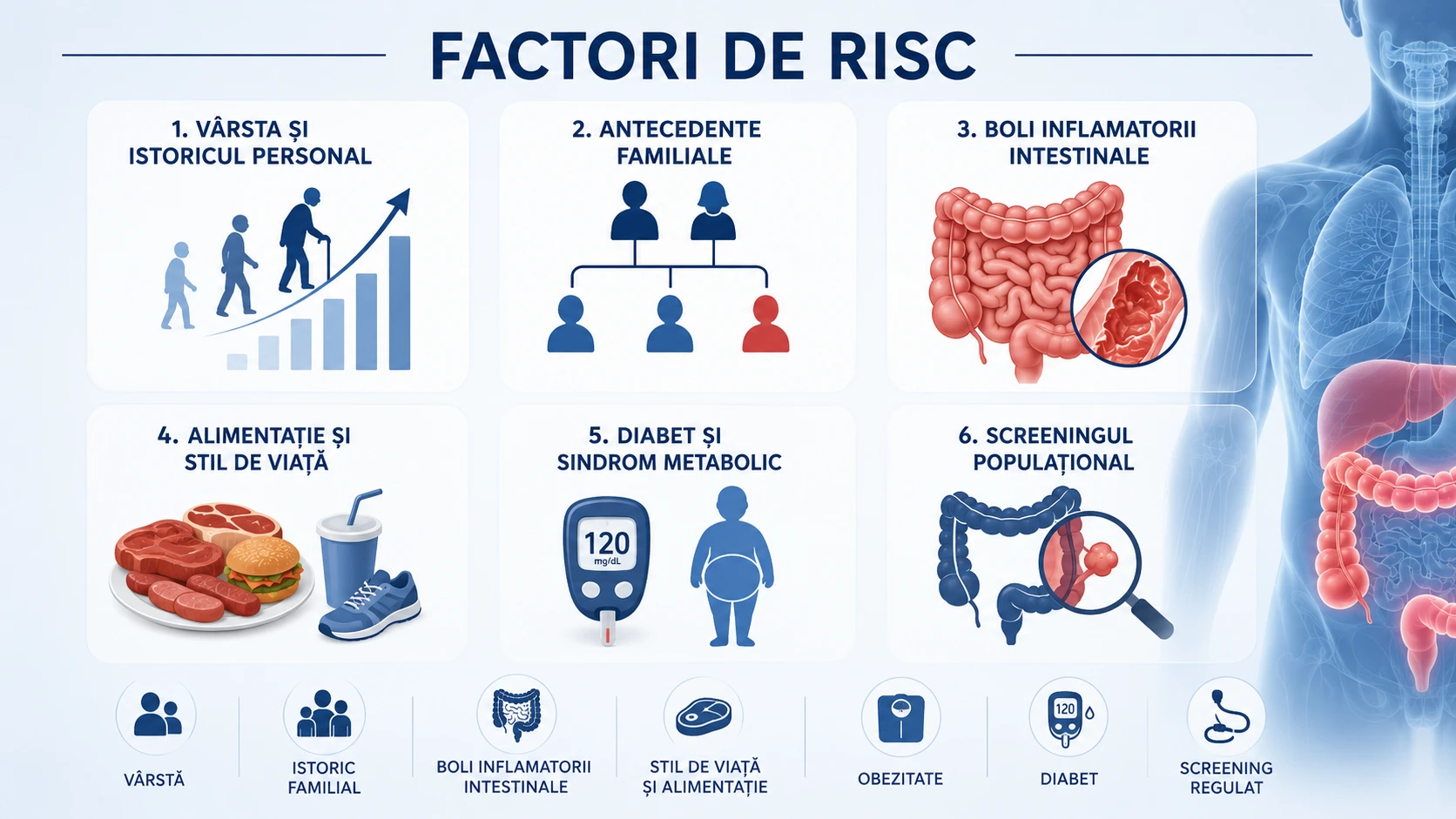
The main risk factors for colorectal cancer — age, family history, inflammatory bowel disease, diet, diabetes and the importance of regular screening.
Age and personal history
Risk increases significantly after the age of 50. A personal history of colonic adenomas or colorectal cancer calls for regular endoscopic surveillance.
Family history
First-degree relatives of a patient with colorectal cancer have a two- to three-fold higher risk. Hereditary syndromes (Lynch, FAP) require specific genetic surveillance.
Inflammatory bowel disease
Long-standing Crohn's disease and ulcerative colitis increase the risk of colorectal cancer and require a protocol of regular colonoscopic surveillance.
Diet and lifestyle
High consumption of processed red meat, a sedentary lifestyle, obesity and smoking are modifiable risk factors, with an impact demonstrated in large epidemiological studies.
Diabetes and metabolic syndrome
Insulin resistance and type 2 diabetes are associated with a moderately increased risk of colorectal cancer, independently of other factors.
Population screening
Screening colonoscopy is recommended from the age of 45–50 in the general population and earlier in at-risk groups, allowing precancerous polyps to be detected and removed.
Clinical signs
Symptoms to watch for
Colorectal cancer can develop for a long time without symptoms. When they do appear, they should be investigated without delay.
- Blood in the stool or on toilet paper — a sign that should never be attributed to haemorrhoids alone without further investigation
- Persistent changes in bowel habits — constipation alternating with diarrhoea, stools of altered calibre
- Abdominal pain or cramps with no obvious cause, especially if persistent
- A feeling of incomplete evacuation (rectal tenesmus) — common in rectal tumours
- Unintentional weight loss or marked fatigue with no other explanation
- Iron-deficiency anaemia — detected on blood tests, often the first sign in right-sided colon tumours
The presence of even a single persistent symptom from the list above warrants a surgical consultation and a colonoscopy. Delaying investigations is one of the main factors that negatively affect prognosis.
Emergency situations
Some complications of colorectal cancer may require emergency surgery:
- Acute bowel obstruction
- Colonic perforation with peritonitis
- Massive lower gastrointestinal bleeding
Surgical technique
How do we operate on colorectal cancer?
The choice of surgical technique depends on the location and stage of the tumour, the patient's anatomy and the experience of the operating team.
Laparoscopic hemicolectomy and rectal resection
Laparoscopic colorectal surgery is considered the gold standard for tumours of the colon and upper rectum. The procedure is performed through small incisions (5–12 mm), with magnified visualisation of the anatomical structures.
The oncological principles — clear resection margins, primary vascular ligation, complete mesocolic excision (CME) or total mesorectal excision (TME) — are observed with the same rigour as in open surgery.
- Reduced postoperative pain and faster recovery
- Shorter hospital stay (3–5 days versus 7–10 in open surgery)
- Lower risk of abdominal wall complications (incisional hernias)
- Earlier return of bowel function
- Oncological outcomes equivalent to the open technique
Laparoscopic procedures
Robotic colorectal resection — da Vinci Xi
The da Vinci Xi robotic system offers a significant technical advantage in rectal surgery, owing to the confined pelvic space and the need for fine dissection close to the autonomic nerve structures.
The robotic arms with 7 degrees of freedom and magnified 3D visualisation allow precise mesorectal dissection, with a lower risk of injury to the nerves responsible for sexual and urinary function.
- Total mesorectal excision (TME) with superior precision
- Optimised autonomic nerve preservation
- Higher rate of anal sphincter preservation
- Camera stability — tremor-free — in narrow anatomical spaces
- 3D visualisation with magnification up to 10×
Robotic indications
Open surgery (laparotomy)
Open surgery via laparotomy remains indicated in specific situations: locally advanced tumours with extensive adhesions, emergency operations (obstruction, perforation), or cases where laparoscopic or robotic access is not feasible.
- Direct access and rapid vascular control in emergencies
- Possibility of manual palpation to assess extension
- Indicated for tumours with vascular or adjacent-organ invasion
- No contraindications related to pneumoperitoneum
Types of resection
Oncological expertise
A second opinion — a responsible decision
“A second opinion is not distrust, it is responsibility.”
If you have received a diagnosis of colorectal cancer or have been recommended surgery and would like a further assessment, Dr Dan Liviu Vasile offers an oncological second-opinion service, including a complete review of the medical file and a proposed treatment strategy based on his experience in oncological surgery in France.
The oncological second-opinion consultation requires the medical documents (imaging, pathology, laboratory work-up) to be sent in advance.
Consultations and surgical procedures
Book a consultation
Dr Dan Liviu Vasile practises in Romania and France, offering specialist consultations and oncological surgery in modern medical centres with infrastructure dedicated to the care of cancer patients.
ELYTIS Nicolina Oncology and Radiotherapy Hospital
Periodic colorectal oncological surgery consultations at the ELYTIS Nicolina Hospital in Iași. A medical centre with infrastructure dedicated to diagnosis, multidisciplinary assessment and oncological treatment.
Iași, Romania
Medima Focșani — MRI · CT
Periodic colorectal oncological surgery consultations at Medima Focșani. A centre with access to advanced diagnostic imaging, multidisciplinary assessment and a personalised treatment plan.
Focșani, Romania
Patients can benefit from specialist consultations, preoperative assessments, a second medical opinion and postoperative monitoring, depending on the specifics of each case.

